What comes after democracy?
For long we could tell ourselves that parliamentary democracy is the final outcome when societies develop enough. Develop, as in that a large enough part of the population is able to enjoy education, public services such as health care are universally available and individual citizens are able to live their lives in relative freedom and comfort.
Francis Fukuyama famously declared the 'end of history' and prophesied that eventually every country would adopt liberal democracy as their form of administration, if they hadn't already. Fukuyama's assertion came after the collapse of the Soviet Union, which ended the Cold War, and drew on Marx' ideas about lineair progression for instance. Fukuyama has since 'updated' his hypothesis, in light of the rise of Islamism, China, Russia and the democratic backsliding in countries like Turkey or Hungary. However, he still maintains that liberal democracy has so much more to offer than autocratic regimes and will therefore prevail, just maybe on a longer term.
Fukuyama has taken enough stick, but I want to reiterate one criticism against his prognosis: the idea that a democracy is inherently tied to some form of 'free' market. Even if I would be willing to work with the hypothesis that a free market could exist, in my hardly humble opinion 'the market' has proven to be not the foundation of a democratic society, but its biggest threat.
I don't even really think I need to elaborate that statement at great lengths to convince anyone: the examples are everywhere and in plain sight for everyone who wants to see. This somewhat populist joke seems to hold more than a kernel of truth: if you are poor, you pay your taxes. If you have a bit more money, you pay an accountant to help you pay as little taxes as you can. And if you are rich, you pay a politician to help you pay no taxes at all.
If you are poor, you pay your taxes. If you have a bit more money, you pay an accountant to help you pay as little taxes as you can. And if you are rich, you pay a politician to help you pay no taxes at all.
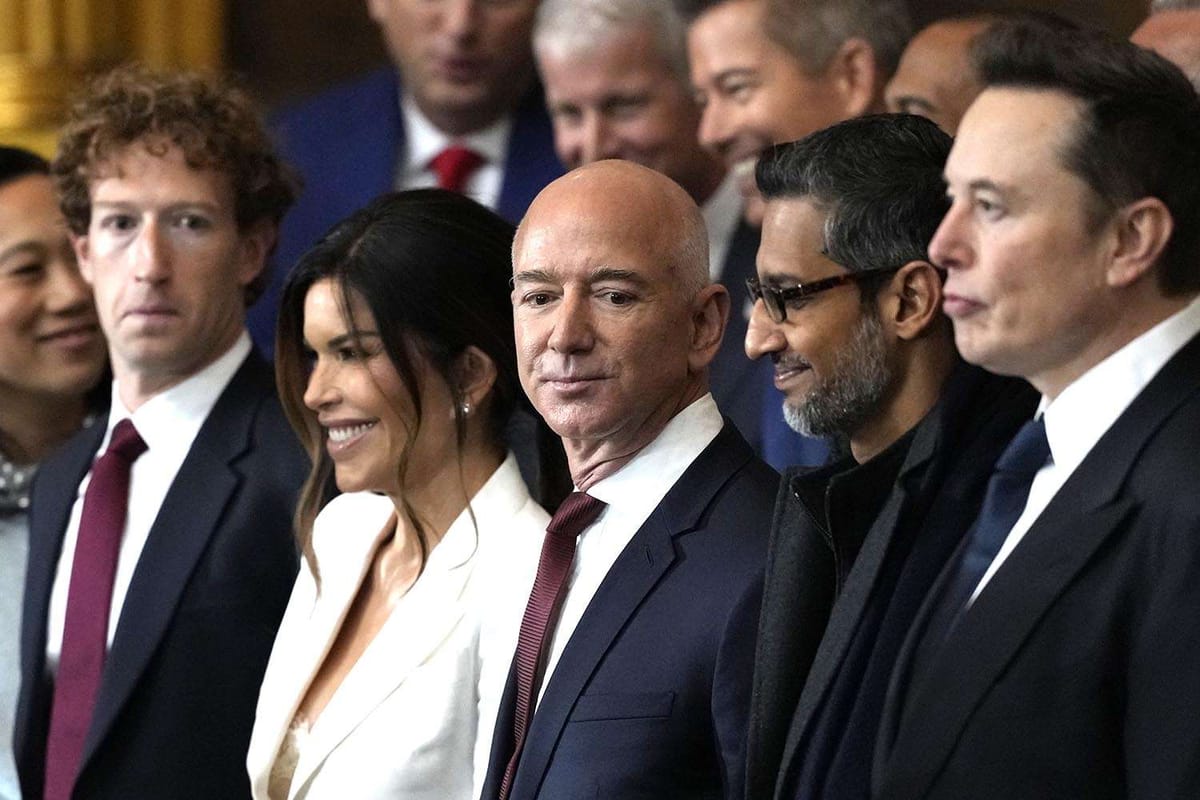
The joke is simplistic and populist, but one might also say it's a bit naive. The ultra rich don't stop at dodging, sorry evading, sorry avoiding taxes, but use their connections to actively acquire public money for their own good. According to an analysis by the Washington Post (ironically a newspaper with another ultra rich owner Jeff Bezos) Musk's various firms have benefitted from subsidies and tax breaks amounting up to $38 billion. That surely makes the whole being a 'business genius' thing a bit easier, one would think. Bezos' Amazon managed to acquire $11.6 billion, as far as we know, whereas Mark Zuckerberg's Meta managed to only get a puny $2.9 billion. But Meta might very well land a $3.3 billion subsidy for building a datacenter in Louisana, so no need to feel sorry for Zuck. And don't forget that these analyses have not yet been able to factor in the enormous amounts of money that are invested in the AI firms, in what is ostensibly a ham-handed way to stay ahead of the curve (meaning: China). It's safe to assume that this picture is similar for other companies close to the White House. The qualification as oligarchy is really not that far fetched.
And if anyone still wants to utter that the ultra rich (firms) also pay a lot in taxes, one can assume they are very naive or posing as such: it is clear that the largest firms and most of the richest people do not pay their fair share of taxes. An analysis by ProPublica of IRS files showed that the true tax rate for Musk was 3.27%, where Michael Bloomberg only paid 1.30%, Jeff Bezos even less with 0.98%, whereas Warren Buffet, often championed as an enlightened billionaire, was actually the champion of almost not paying taxes, with a true tax rate of 0.10%. To clarify, the highest federal tax rate in the USA is actually 37% for a yearly income above $628,300. And to further clarify: this is not an accusation of wrongdoing, as tax avoidance is perfectly legal. Immoral, but perfectly legal.
The qualification as oligarchy is really not that far fetched.
But wait, there's more! Of course the most important part is the grift: the ultra rich provides us ample evidence that greed grows exponentially. But in order for the daylight robbery to go unnoticed, alongside the commandeering of government, voters need to be distracted. And again, I don't need to explain the knowledgeable reader how the voters are being distracted: we are bombarded with messages that imply we are under threat. Under threat from 'others', meaning foreigners, Muslims, Jews, black people, brown people, Asians, 'woke', trans people, and the list goes on, endlessly. And where I only discussed the USA so far, because that's where the model is most manifest, their culture wars have (been) spread to the rest of the world too. Via the same media, the unhinged Twitter/X, Meta's Facebook and now also TikTok, alongside the legacy media, the message is now spread worldwide that our societies are crumbling, not because those who benefit most from it don't contribute to it, but because of 'others'.
The message is now spread worldwide that our societies are crumbling, not because those who benefit most from it don't contribute to it, but because of 'others'
Those media are almost all owned or controlled by the aforementioned ultra rich. The exception was TikTok, but its American version will now be controlled by Larry Ellison and Marc Andreessen, of Oracle and Andreessen Horowitz, and friends of the White House. Twitter/X was acquired by Elon Musk for the explicit goal to give 'free speech' free rein, making it able to spread rightwing propaganda, no longer monitored and with impunity. Or as he put it himself, because he loves humanity. Again, according to his own admission, he believes Trump would have lost the election without him. We can't know that for sure, but we do know that Twitter/X in its unmonitored form has been used to divulge disinformation and to manipulate the public discourse.
In 2024, Twitter/X and TikTok helped spread the false information that a man who killed three children in a knife attack was a radical Muslim immigrant, although he was actually a UK-born son of Christian immigrants. [None of these things were relevant, as his deeds are most likely best explained by his established psychiatric condition] The false information spread like a wildfire leading to riots and mosques were attacked across the country. Also, because the public had been fed a steady diet of misinformed xenophobia for years already.
Misinformation, again spread via social media such as Facebook, played a possibly decisive role in tipping the balance towards a Brexit in the UK- referendum of 2016. Using data harvested via Facebook profiles, with the knowledge of Facebook, a company called Cambridge Analytica targeted users that were most likely to believe certain information with targeted political ads, that were let's say not necessarily factually correct. A portion of the electorate was for instance led to believe that immigration was to blame for the deterioration of their status and position, and society in general, and that leaving the EU would decrease or even end immigration. Especially older people, people with lower incomes including the unemployed, and people with lower education levels voted for the UK to leave the EU, being convinced that this would benefit them. It is safe to say that this did not pan out that way, but even worsened their positions. According to the National Bureau of Economic Research's working paper of the Economic Impact of Brexit it is estimated that UK's GDP per capita decreased 6-8%, whereas employment decreased 3-4%. In my words: the voters were fed lies and this helped steer the country in a direction that made things worse for them. Bregret is real: only 30% still believe leaving the EU was the right choice.
But that ship has sailed and even if the UK were to decide to return to the EU, reversing the damage, if possible, would take decades. In that same EU, Hungary recently managed to free itself of Orban's illiberal democracy, despite the explicit support from the USA and rightwing voices like Elon Musk. Losing Hungary may signal that the ultra rich may need to explore new venues of influencing (I am attempting to be nuanced here) the administrations of countries. But what might that entail? Surveillance capitalism is one possible, and depressing answer.
Surveillance (or data) capitalism is the term used to describe the commodification of data by corporations and it being used to monitor people. Corporations have used such data to profile 'users' in order for them to optimize advertising. But as we saw in the Cambridge Analytica case such advertising can go beyond selling people things to selling people ideas. And even more sinister, the monitoring can also be used to surveil people, by corporations, and by authorities. Already in 2018, Bloomberg published an exposé about how data mining company Palantir, founded by Peter Thiel and some of his PayPal pals, helped JPMorgan spy on their employees after working hours. "Using the technology, JPMorgan looked for signs of upset and irritated employees to help prevent insider threats against the company." Palantir has since gathered more data, about you and I, and more contracts with companies, government agencies and governments. These customers include healthcare providers and insurance companies, for instance. Information about your and my health may already be in the Palantir database, commodified and up for sale. Maybe your next potential employer deems your liver values a risk and refuses to interview you. Or maybe your mortgage provider decides to increase the interest on the basis of your last medical check-up.
And things are possibly even worse when government agencies get into bed with companies such as Palantir. Thankfully Palantir's CEO Alex Karp wrote a hallucinant manifesto on Twitter/X that clarifies, or rather exposes how far along the path of techno-fascism they are (Elliot Higgins of Bellingcat fame wrote this analysis on Bluesky). According to Karp, governments, and specifically the US should use technology to essentially exert their power without taking morals into account, or without accountability per se. Karp also expresses an infantile variation of the rejection of cultural relativism, stating "Some cultures have produced vital advances; others remain dysfunctional and regressive. All cultures are now equal. Criticism and value judgments are forbidden. Yet this new dogma glosses over the fact that certain cultures and indeed subcultures . . . have produced wonders. Others have proven middling, and worse, regressive and harmful." Shallow and unintelligent would be my kindest feedback here.
I don't assume Karp and his fellow supervillains will loose much sleep over my scorn
I don't assume Karp and his fellow supervillains will loose much sleep over my scorn, as I am but an angry academic, and Palantir and the likes hold real power. And we are talking about the power to direct governing agencies, law enforcement and the military for instance. If Palantir reads this little rant, I might end up on the naughty list and who knows where that would take us. Jest aside, our democracies are in real peril: the USA does not have a functioning democracy at the moment of writing, and the EU's democracies survive as long as they manage to keep the rightwing extremist parties out of government. And that is not a given at any rate. The dangers are very clear and I don't think it is hyperbolic that we have arrived at the stage of post-democracy.
What we need to do, is think of alternative ways of getting out of this mire. I realise this is not an answer to the question posed in the title. We will have to get there in my next episodes.